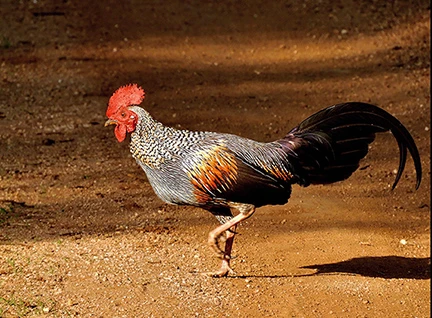
Polyplectronini
A bird tribe known for cryptic plumage and defensive spurs.
Polyplectronini is a tribe of birds within the family Phasianidae, comprising the genus Polyplectron (peacock-pheasants) and their closest relatives. These birds are notable for their inconspicuous coloration and reliance on crypsis, but when threatened they display specialized plumage with iridescent orbs and vibrate their quills as aposematic signals. They possess well-developed metatarsal spurs, with older individuals sometimes having multiple spurs on each leg, used in self-defense.
- field
- Ornithology
- known_for
- Crypsis, aposematic display with iridescent orbs, and multiple metatarsal spurs
- number_of_species
- Eight in Polyplectron
- closest_allies
- Asiatic spurfowl and crimson-headed partridge
- type_species
- Grey peacock-pheasant
Lore & Background
The genus Polyplectron was introduced in 1807 by Dutch zoologist Coenraad Jacob Temminck, with the name combining Ancient Greek 'polus' (many) and 'plēktron' (cock's spur). The type species is the grey peacock-pheasant. Molecular research has revealed that peacock-pheasants are not genetically related to pheasants and only distantly to peafowl; their closest allies are the Asiatic spurfowl and the crimson-headed partridge, endemic to Borneo. These three genera share a curious tendency for multiple metatarsal spurs and have nearly identical skeletons despite morphological divergence.
Reader's Guide
The tribe Polyplectronini is significant for its unique evolutionary adaptations, including crypsis and aposematic displays using iridescent orbs and quill vibration. Their systematics remain somewhat unclear, with molecular data showing they are not closely related to pheasants or peafowl. The species diverged between the Early Pliocene and Middle Pleistocene (5–1 million years ago). A notable trend in the genus is the loss of pronounced sexual dimorphism, supported by biogeographical and molecular data. The Hainan peacock-pheasant, endemic to Hainan Island, is severely endangered with a declining wild population, and its recognition as a full species is considered of utmost importance for conservation.
Did You Know?
- Peacock-pheasants rely heavily on crypsis to avoid detection.
- When threatened, they expand specialized plumage revealing numerous iridescent orbs and vibrate their plume quills.
- Older individuals may have multiple metatarsal spurs on each leg, used in self-defense.
- The Hainan peacock-pheasant is among the rarest species in the order Galliformes in China.
More in Bird tribes 1-24
Spotted an error? Know more?
This is a living reference — every entry is fact-audited, and reader corrections feed straight into our audit queue. Suggest an edit · See this site's audit record